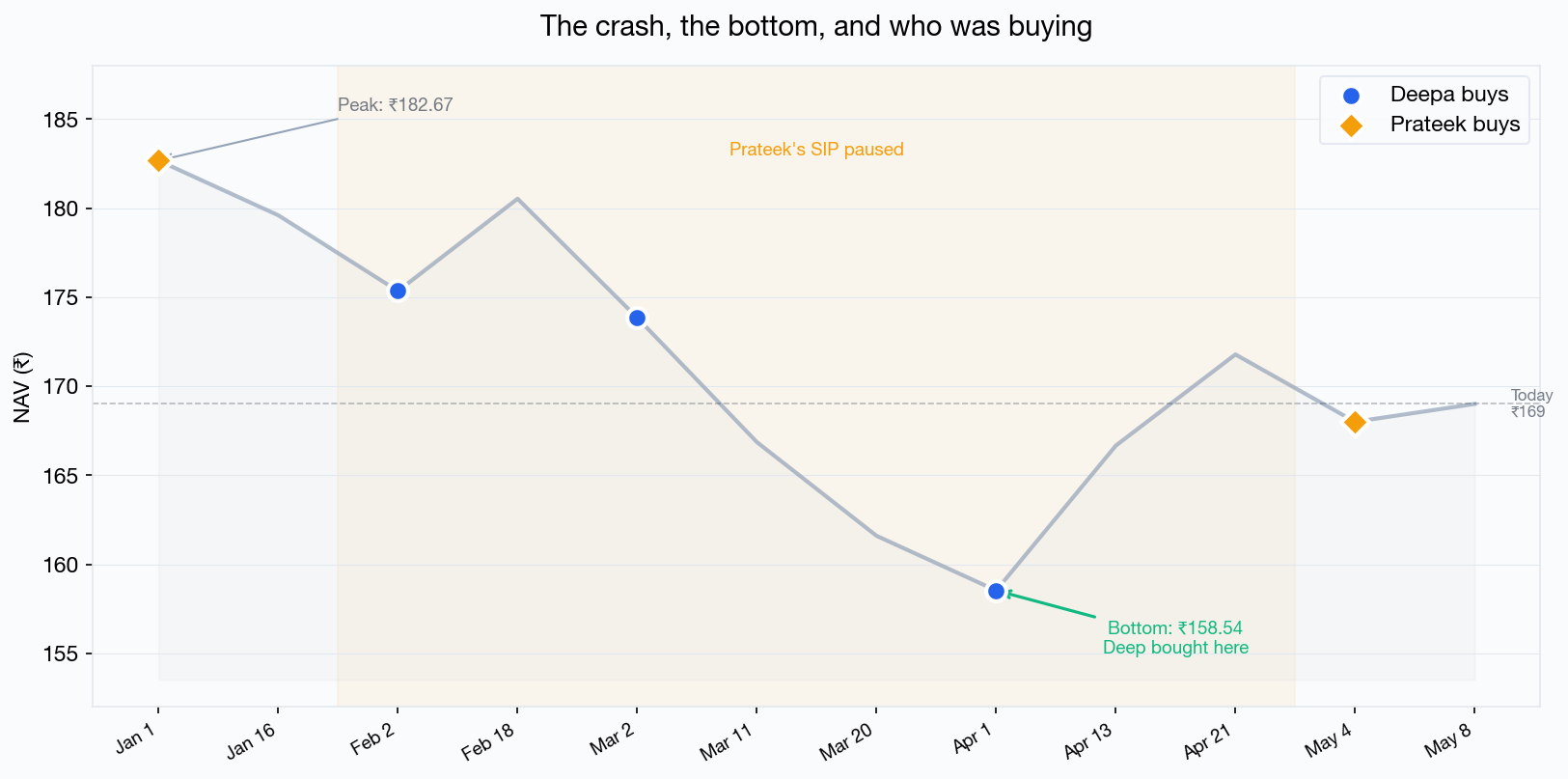
Nifty fell 15% between January and March 2026. The worst quarter since COVID.
If you paused your SIP during those months — you're not alone. The SIP stoppage ratio hit 100% in March. But was it the right call?
We took two investors with identical ₹25,000/month SIPs into a Nifty 50 index fund and simulated what actually happened to their money.
Meet Deepa and Prateek
Deepa didn't touch anything. Auto-debit ran. She didn't even open her broker app.
Prateek saw the headlines — Iran, oil, FII outflows — and paused his SIP in February. Resumed in May once things calmed down.
Same fund. Same amount. Same 5 months. One decision different.
What They Actually Bought
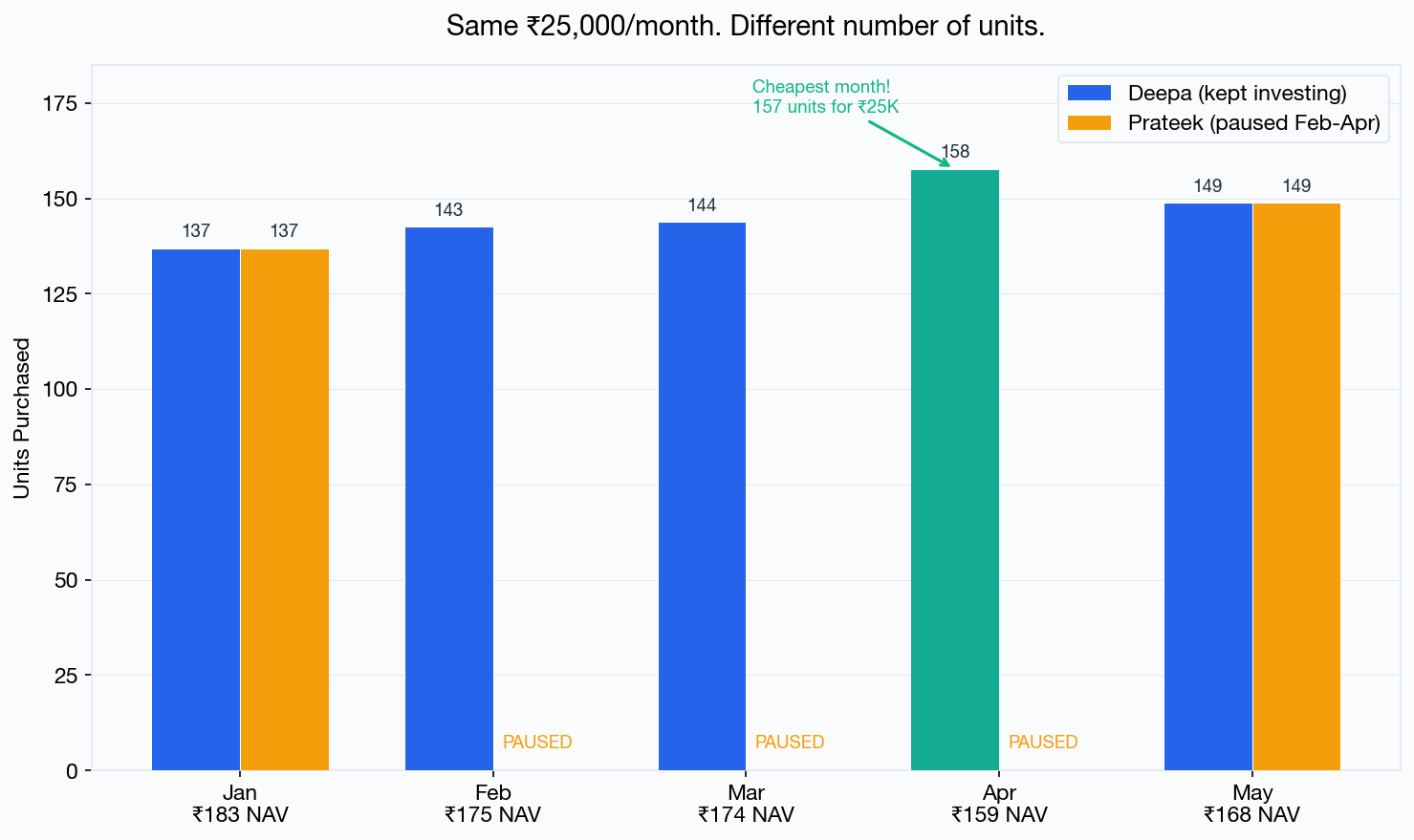
Here's the thing most people miss: April was the cheapest month. NAV hit ₹158.54 — the lowest in over a year. Deepa's SIP automatically bought 157.7 units that month. Her most units in any single month.
Prateek's SIP was paused. He missed the biggest discount.
| Deepa | Prateek | |
|---|---|---|
| Total units owned | 730 | 286 |
| Cash in hand | ₹0 | ₹75,656 |
| Average cost per unit | ₹171.30 | ₹175.03 |
So Who's Winning?
Today (May 8, 2026): Prateek. By ₹606.
The market hasn't fully recovered. Deepa's crash purchases are roughly flat. Prateek's cash didn't lose value. Caution paid off — for now.
But Prateek still has ₹75K sitting in savings. He'll invest it eventually. The question is: at what price?
That depends on which future plays out.
Three Futures, Three Winners
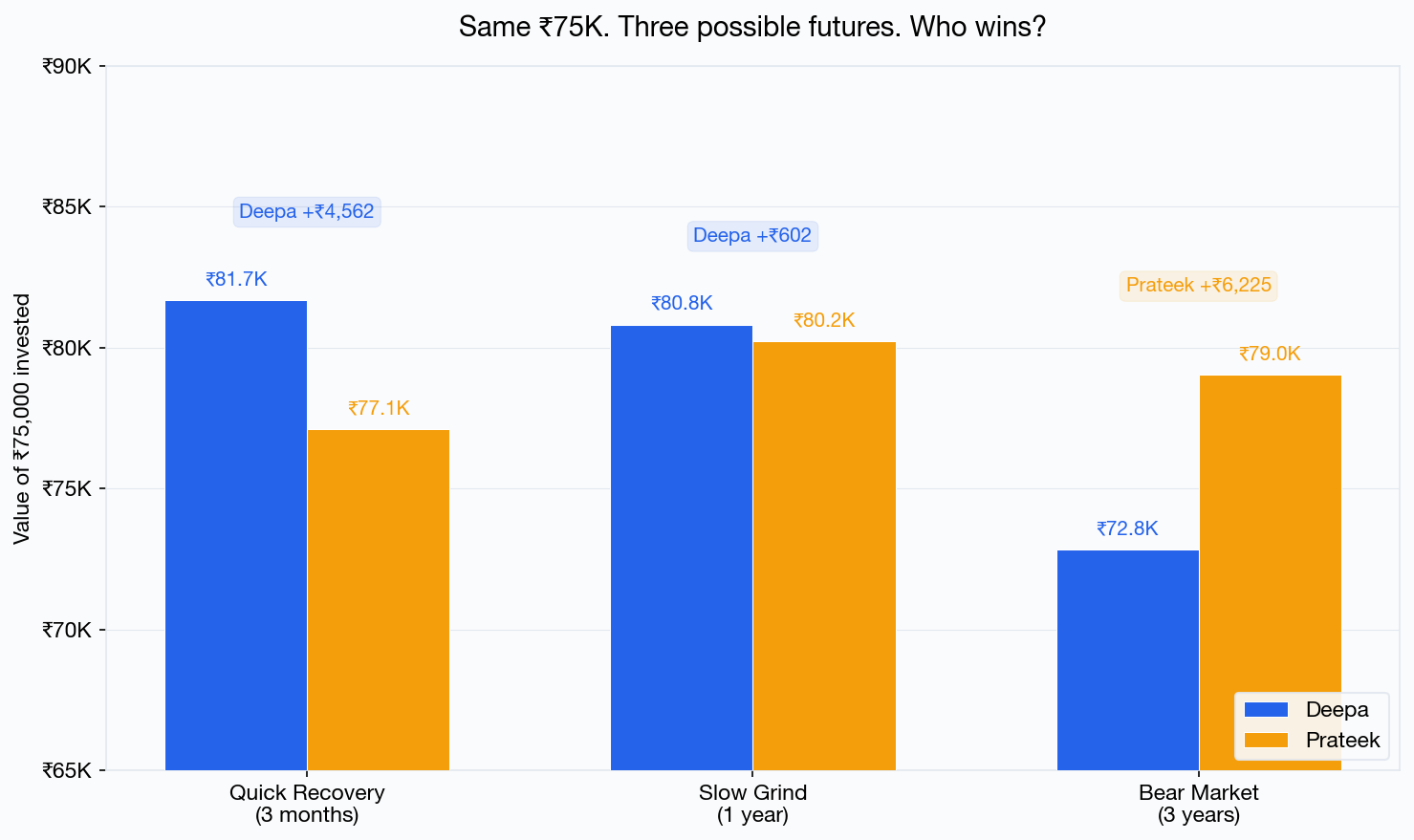
If the market recovers in 3 months
Prateek invests his ₹75K as the market rises back to its January peak. He buys at ₹174-184. Deepa already bought at ₹158-175.
Deepa wins by ₹4,562. She locked in crash prices. Prateek paid recovery prices.
If the market grinds sideways for a year
Prateek invests his ₹75K at roughly current levels (~₹170). Market eventually recovers by mid-2027.
Deepa wins by ₹602. Barely. But her April purchase at ₹158.54 still gives her the edge.
If the market keeps falling for 3 years
Nifty drops further. Stays around 22,000-23,000. Prateek invests his ₹75K at ₹152-160 — even cheaper than Deepa's crash buys.
Prateek wins by ₹6,225. He got luckier prices because the crash deepened after he paused.
The Scoreboard
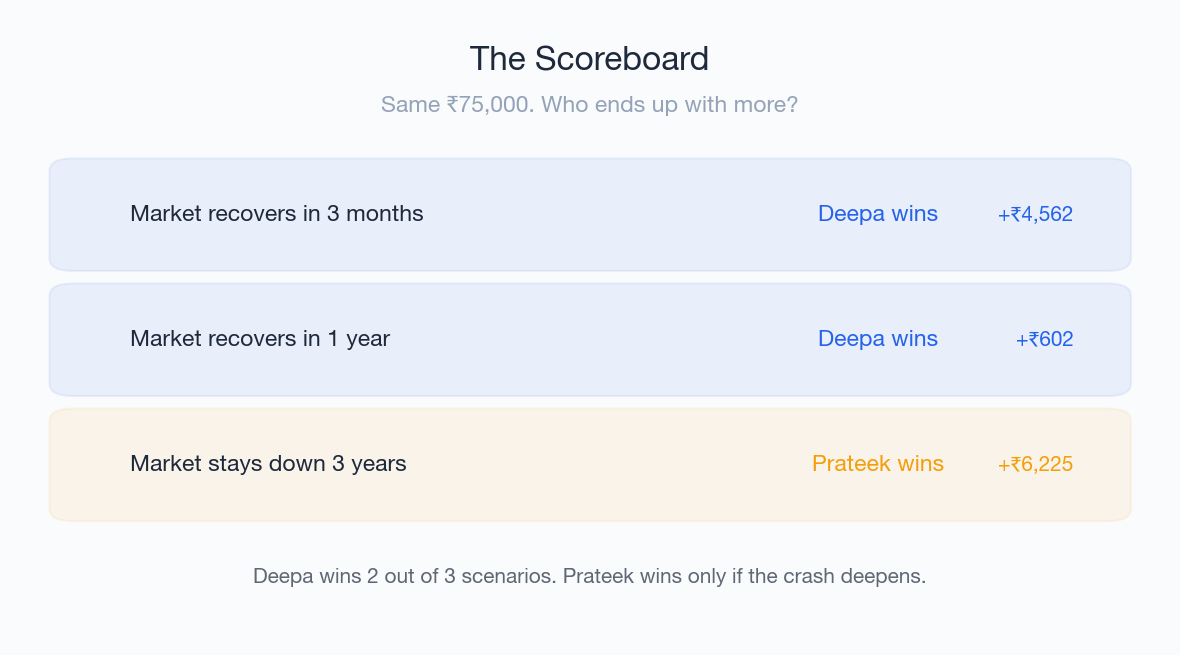
| What happens next | Winner | By how much |
|---|---|---|
| Market recovers quickly | Deepa | +₹4,562 |
| Market recovers slowly | Deepa | +₹602 |
| Market keeps falling | Prateek | +₹6,225 |
Deepa wins in 2 out of 3 scenarios. Prateek wins only if the market falls further after he pauses — meaning the crash wasn't the bottom.
The Bet You're Making
When you pause a SIP during a crash, you're betting: "This will get worse."
If you're right, you buy cheaper later. If you're wrong, you missed the discount.
Historical base rate: Indian markets have recovered from every 15%+ drawdown. Median recovery time from a fall this size: 8-14 months. A multi-year bear market where Nifty stays below its previous peak has always eventually resolved upward.
Doesn't mean it can't happen. Means you're betting against the base rate.
The Part Nobody Talks About
This simulation is generous to Prateek. It assumes he reinvests his ₹75K within 3 months of resuming.
In reality? Most people who pause don't resume at ₹170. They wait for "clarity." Clarity arrives at ₹185. By then, the discount is gone.
The biggest risk of pausing isn't the market. It's that pausing becomes the default.
Your Numbers
The math scales linearly: - ₹10K/month SIP → divide all numbers by 2.5 - ₹50K/month SIP → multiply by 2
The question isn't about the amount. It's about which future you think is most likely.
Data: UTI Nifty 50 Index Fund - Direct Growth, actual NAVs from Jan-May 2026 Source: mfapi.in | Analysis date: May 2026
Run these numbers on your finances
Arth looks at your full picture and tells you what actually matters.
Try Arth →